
What a Workplace Injury Treatment Clinic Does

Updated: Jul 11

When an injury happens on the job, the first question is usually simple: where should you go right now? A workplace injury treatment clinic is designed for exactly that moment - when you need prompt medical care, clear documentation, and a treatment plan that helps you recover without getting lost in a complicated system.
For many employees, the challenge is not just pain. It is figuring out who treats the injury, what paperwork is needed, whether work restrictions apply, and how follow-up care will be handled. For employers, the stakes are also high. Delays in treatment can lead to longer time away from work, poor communication, and unnecessary confusion. That is why the right clinic matters.
What a workplace injury treatment clinic is meant to handle
A workplace injury treatment clinic focuses on job-related injuries and occupational health needs. That includes sudden injuries like slips, falls, strains, cuts, crush injuries, and back pain after lifting. It can also include repetitive stress conditions that build over time, such as tendonitis, carpal tunnel symptoms, and shoulder or wrist pain tied to repeated motion.
The key difference between this type of clinic and a general care setting is coordination. Treatment is only one part of the visit. A strong clinic also understands workers' compensation processes, employer reporting requirements, modified duty recommendations, and the need for timely follow-up.
That does not mean every workplace injury needs the same level of care. Some cases are straightforward and improve with rest, medication, bracing, or physical therapy. Others need imaging, orthopedic evaluation, hand care, or a more structured rehabilitation plan. The best setting is one that can recognize the difference early and move the patient to the right next step without delay.
Why speed matters after a work injury
With work injuries, waiting often makes things harder. A strain that seems minor on day one can become more painful after a few shifts. A hand injury that is not properly evaluated can affect grip strength, swelling, and function. Even when the injury is not severe, delayed care can create gaps in documentation that complicate the workers' compensation process.
Fast access matters for medical reasons and practical ones. Early evaluation helps confirm what was injured, what treatment should start now, and whether the employee can safely return to work with restrictions. It also gives both the patient and employer a clearer path forward.
In an outpatient setting, that speed can make a real difference. Many patients want to avoid the long waits and fragmented follow-up that often come with larger hospital systems for non-emergency injuries. A clinic built around urgent access and coordinated specialty care can keep the process more manageable from the start.
What to expect at a workplace injury treatment clinic visit
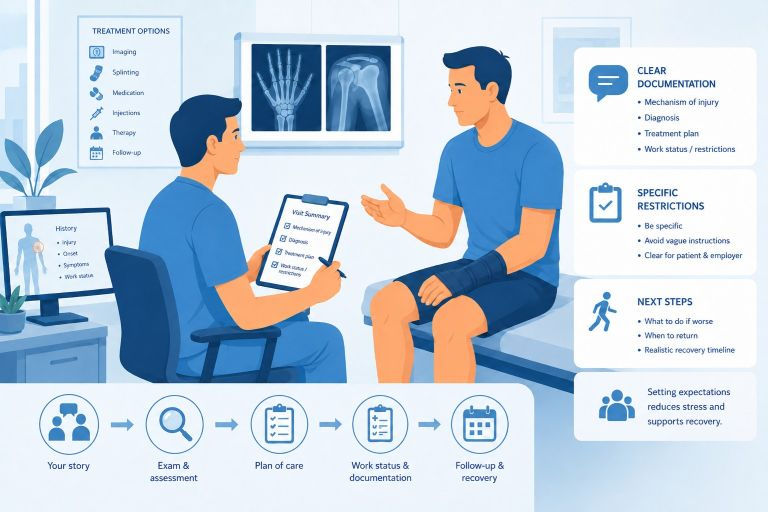
The first visit usually starts with the story of how the injury happened, when symptoms began, what body part is affected, and whether the patient can continue working safely. The provider will examine the injury, assess pain and function, and determine whether imaging, splinting, medication, injections, therapy, or specialist follow-up is needed.
Just as important, the visit should produce clear documentation. In workplace cases, medical records often need to reflect the mechanism of injury, diagnosis, treatment plan, and work status. If restrictions are appropriate, they should be specific. Vague instructions are frustrating for both patients and employers because they leave too much open to interpretation.
Good clinics also explain the next steps in plain language. Patients should leave knowing what to do if symptoms worsen, when to return, and what kind of recovery timeline is realistic. Not every injury improves on the same schedule, and setting expectations early can reduce stress.
The value of all-in-one care
One of the biggest advantages of a well-equipped workplace injury treatment clinic is convenience. If a patient needs urgent evaluation, imaging review, orthopedic care, physical therapy, and work status updates, it helps when those services are coordinated in one place.
That kind of integrated model tends to work especially well for musculoskeletal injuries. A back strain may need initial pain control and restrictions, followed by therapy and reassessment. A shoulder injury may start in urgent care but later require orthopedic expertise. A hand injury may need a more specialized exam to protect long-term function. When providers can coordinate under one roof, patients spend less time repeating their story and more time focusing on recovery.
For busy adults, convenience is not a small detail. It affects whether people actually follow through with treatment. If care is hard to schedule, split between too many offices, or delayed by poor communication, recovery can stall.
Workplace injury treatment clinic care is not one-size-fits-all
Some work injuries look similar at first but need different treatment. Low back pain after lifting could be a simple strain, or it could point to disc involvement, nerve irritation, or a flare of a preexisting issue. Wrist pain might be a sprain, tendon injury, or repetitive use condition. Knee pain after a fall may respond to conservative care, but swelling, instability, or limited weight-bearing may call for closer orthopedic follow-up.
This is where clinical judgment matters. A dependable clinic does not overcomplicate minor injuries, but it also does not dismiss problems that need more attention. The goal is to treat what can be managed quickly while identifying cases that need additional evaluation.
There is also the question of work status. Some patients can return right away with temporary restrictions. Others need time off, especially if the job is physically demanding or safety-sensitive. A thoughtful plan should match the actual job duties, not just the diagnosis on paper.
Why documentation and communication matter so much

Work injuries sit at the intersection of medicine and administration. That can be frustrating for patients who just want relief. Still, accurate paperwork matters because it supports continuity of care and helps prevent delays in authorization, follow-up, and return-to-work decisions.
A clinic experienced in occupational medicine usually understands how to document work restrictions, communicate with employers when appropriate, and support workers' compensation workflows. That does not replace treatment - it supports it. When medical care and administrative steps are aligned, patients are less likely to feel stuck between their employer, adjuster, and provider.
For employers, that same clarity helps with scheduling, modified duty planning, and compliance. For employees, it helps reduce uncertainty during an already stressful time.
Follow-up care often determines the outcome
The first visit gets attention because it happens right after the injury, but follow-up is often what shapes the result. If pain is not improving, if movement remains limited, or if the patient cannot perform essential job tasks, the plan may need to change.
That can mean adding physical therapy, ordering further evaluation, or involving a specialist. It can also mean adjusting work restrictions based on how the recovery is progressing. The most helpful clinics do not treat workplace injuries as one-and-done visits. They track improvement, respond to setbacks, and keep care moving.
This is especially important for injuries affecting the back, neck, shoulder, knee, and hand. These problems can interfere with daily function long after the initial event if they are not managed carefully. Early treatment helps, but so does having a clinic that can continue care without unnecessary friction.
Choosing the right workplace injury treatment clinic
If you are looking for care after a job-related injury, practical factors matter. You want a clinic that can see patients quickly, understands workers' compensation, and offers access to the services many injury cases actually need. That may include urgent care, orthopedic evaluation, hand expertise, physical therapy, and clear work status reporting.
It also helps to choose a setting that is easy to access. Walk-in availability, efficient scheduling, and telemedicine for appropriate follow-up can make the treatment process less disruptive. That matters for workers trying to recover and for employers trying to keep operations running.
The right clinic should make the next step feel obvious, not harder. After a workplace injury, good care is not only about treating pain. It is about helping you understand what happened, what comes next, and how to move forward with confidence.


Comments