
When to Go to an Orthopedic Doctor For Firework Injury


A fireworks accident can turn a celebration into an emergency in seconds. If you are searching for an orthopedic doctor for a firework injury, it usually means the injury involves more than a simple burn. Explosions and impact injuries can damage bones, joints, tendons, ligaments, and nerves, especially in the hand, wrist, elbow, and shoulder. Fast evaluation matters because delays can make pain, swelling, stiffness, and long-term function worse.
Orthopedic care is often needed when the injury affects movement, grip strength, alignment, or stability. Firework injuries are not always obvious at first. A finger may still move even with a fracture. A wrist may feel like a sprain when there is actually a break or tendon injury. That is why proper imaging and a focused musculoskeletal exam are so important after a blast-related injury.
When to see an orthopedic doctor for firework injury
Some symptoms should not wait. If you have severe pain, visible deformity, swelling that is getting worse, numbness, weakness, trouble moving a finger or wrist, or bleeding that does not stop, you need prompt medical attention. The same is true if part of the hand was directly struck by an exploding device or if metal, paper, or debris may be embedded in the skin.
Even if the wound looks small, the force of a firework can create deeper damage. A blast can fracture small bones in the hand, dislocate joints, tear tendons, or injure cartilage. Patients sometimes focus on the burn and miss the orthopedic problem underneath. In these cases, treating only the surface injury is not enough.
Children and working adults should be especially careful about follow-up. A missed hand injury can affect school, driving, typing, lifting, tool use, and daily tasks for weeks or months. Early diagnosis often gives you more treatment options and a better chance of healing with less stiffness.
Common orthopedic injuries after fireworks

The most common orthopedic patterns involve the hand because people hold fireworks or are standing close when they ignite. Fractures of the fingers, metacarpals, and wrist are common. Joint dislocations can happen from blunt force. Tendon injuries may limit your ability to bend or straighten a finger. Ligament damage can leave a joint unstable even after the swelling goes down.
Higher-force accidents may also injure the forearm, elbow, or shoulder. Falls during a firework accident can lead to a broken wrist, elbow fracture, or shoulder dislocation. In some cases, the initial adrenaline masks the severity of the injury. Patients come in later because they cannot grip, rotate the arm, or lift the shoulder without pain.
There is also an important difference between pain and function. Some injuries are painful but stable. Others may seem tolerable yet involve significant structural damage. That is why orthopedic assessment focuses on both how much it hurts and how well the limb is working.
What evaluation and treatment may involve
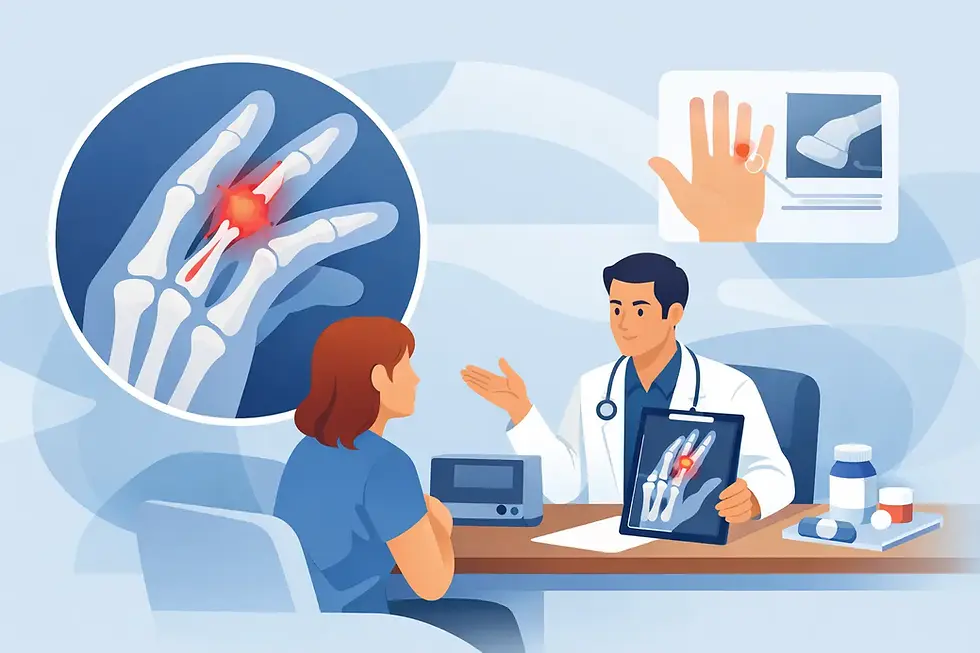
A firework injury orthopedic doctor will usually start with a physical exam, wound assessment, and imaging such as X-rays. If a tendon, nerve, or more complex hand injury is suspected, additional specialty evaluation may be needed. The goal is to identify fractures, alignment problems, joint instability, and soft tissue damage as early as possible.
Treatment depends on the pattern of injury. Some patients need splinting or casting. Others need wound care, reduction of a dislocation, bracing, pain management, or referral for hand surgery. If there is contamination from debris, the wound may require careful cleaning and close monitoring. Burns and orthopedic trauma often happen together, so coordinated care is especially helpful.
Recovery does not stop after the first visit. Follow-up may include repeat imaging, activity restrictions, work-status documentation, and physical or occupational therapy to restore motion and strength. This matters because stiffness can set in quickly, particularly in the hand. Good early care is important, but good follow-through is what helps patients return to normal use.
Why coordinated injury care matters
After a firework accident, patients often need more than one service. They may need urgent evaluation, orthopedic treatment, hand-focused care, pain relief, and rehabilitation. Getting those services organized quickly can save time and reduce frustration, especially if the injury affects work or daily responsibilities.
This is where an outpatient setting can make a real difference. Instead of navigating multiple offices, many people prefer a clinic that can evaluate the injury, order imaging, manage follow-up, and coordinate therapy in one place. A&C Medical Center is built around that kind of practical, fast-access care for musculoskeletal injuries.
Do not ignore "minor" symptoms
Some of the most stubborn post-firework problems start with symptoms people try to push through. Swelling, bruising, reduced grip, fingertip numbness, or pain with rotation can all point to a deeper injury. If symptoms are not improving quickly, or if function is getting worse instead of better, you should be re-evaluated.
The right next step is not to wait and hope the hand loosens up on its own. It is to get examined by a provider who understands fracture patterns, soft tissue injury, and the way blast trauma can affect long-term joint function. Prompt care can protect motion, reduce complications, and help you heal with a clearer plan.
Stay safe this Fourth of July
Fireworks can be exciting, but even a small accident can cause a serious injury. Keep a safe distance, never hold fireworks in your hand after lighting them, and avoid picking up anything that did not fully ignite. If an injury happens, do not ignore pain, swelling, numbness, or trouble moving your hand or fingers. Getting checked early can make a big difference in protecting your recovery and long-term function.
Stay safe, celebrate responsibly, and seek medical care right away if something does not feel right.


Comments